How Block Width Sets the Error of an Optimistic QFT, Measured on 16 Qubits
The block width is the one knob inside an optimistic QFT. Narrow blocks make a shallow circuit that fails often. Wide blocks fail rarely but cost more depth. OQFT normally picks the width for you from the error target, but on a register small enough to simulate you can force it with --block-width and watch what happens.
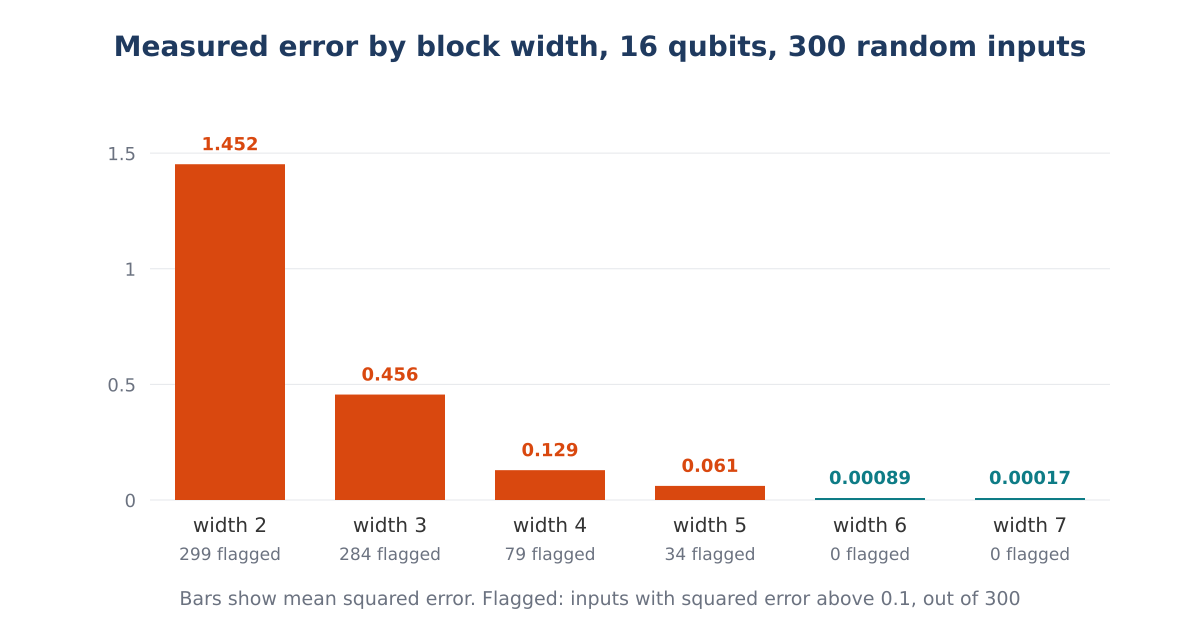
We took a 16-qubit register, forced every width from 2 to 8, and ran 300 random inputs through the simulator for each, with the same seed every time so the run can be repeated. For each input oqft check measured the squared error against the exact QFT, and flagged any above 0.1.
What We Saw
| Block width | Mean squared error | Inputs over 0.1 |
|---|---|---|
| 2 | 1.45 | 299 of 300 |
| 3 | 0.46 | 284 of 300 |
| 4 | 0.13 | 79 of 300 |
| 5 | 0.061 | 34 of 300 |
| 6 | 0.00089 | 0 of 300 |
| 7 | 0.00017 | 0 of 300 |
| 8 | effectively 0 | 0 of 300 |
Squared error runs from 0, a perfect match, to 4. Width 8 splits 16 qubits into two blocks, which is the exact circuit; its error is rounding.
Two-qubit blocks are useless: almost every input comes out wrong. The error drops fast as blocks widen, by two to three and a half times per extra qubit from 2 to 5, and then falls off a cliff at 6, where it drops seventy-fold and no input in the sample crosses the flag.
Why the Cliff
Part of it is how 16 qubits divide. Widths 4 and 5 cut the register into four blocks, widths 6 and 7 into three. Every pair of blocks that aren’t neighbours loses the small rotations between them, and three blocks have fewer such pairs than four, so less is thrown away.
The other part is the edge itself. An input fails when the block being estimated sits close to the top of its range. With w qubits there are 2^w values, so the fraction of risky values halves with every extra qubit, and the smaller errors near the edge shrink too.
What It Means at Real Sizes
On real registers OQFT picks much wider blocks: 14 to 22 qubits at 64 qubits, 22 to 32 at 2,048, depending on the target. At those widths the risky fraction of values is tiny. At an error target of 0.01 a 16-qubit register doesn’t get an optimistic circuit at all: OQFT returns the exact QFT, since blocks that wide would leave only two. That’s why this experiment forces the width by hand.
To repeat it, run oqft check -n 16 --block-width 5 --samples 300 --seed 7. The full output for every width is in the recorded results. How OQFT was tested shows a single block walking into the wraparound edge.